

Development
Demolition of 5 no. blocks (EFAA, EFAB, EFAD, EFAE and EFAF), consequential works to retained building EFAC, construction of a three-storey replacement school building and separate sports block, relocation of playing fields and parking area along with access, landscaping, and associated infrastructure.
Archaeological Consultancy | Archaeological Trial Trench Evaluation
Enfield Council
Supporting a Major School Redevelopment
HEA was commissioned by Bowmer & Kirkland to provide archaeological consultancy services in support of the redevelopment of Chace Community School in Enfield, North London.
The proposals involved the demolition of five existing school buildings, construction of a three-storey replacement school building and separate sports block, together with the relocation of playing fields and parking, new access arrangements, landscaping and associated infrastructure.
Given the site’s archaeological potential and historic land use, planning permission (Ref. 24/00621/FUL) was granted subject to Condition 3, requiring an approved Written Scheme of Investigation (WSI) to establish the methodology for archaeological investigation, recording and reporting.
Understanding the Historic Landscape
The archaeological background identified evidence of prehistoric activity within the wider area, including Palaeolithic and Mesolithic flint artefacts. However, historic mapping provided particularly useful insight into the site’s more recent development.
The 1754 Trinity College Tithe Map showed the site predominantly comprising open land, with evidence of possible orchard planting and a potential early structure in the area subsequently occupied by Churchbury Farm.
By 1803, much of the site was identified as Churchbury Orchard. Later Ordnance Survey mapping showed the development of Churchbury Farm, including farm buildings and associated yards in the northwestern part of the site, alongside extensive orchard planting and areas of plantation woodland.
By the early 20th century, glasshouses had also been established within the northwestern part of the site, reflecting the continued agricultural use of the land.
This historic evidence provided a useful context for understanding the archaeological potential of the site and the types of remains that might survive beneath the later school development.
Managing Archaeological Requirements
HEA coordinated the archaeological response to Condition 3. The Written Scheme of Investigation (WSI) established the investigation methodology, recording requirements, and programme for post-investigation assessment and reporting. Following review and approval by the Greater London Archaeological Advisory Service (GLAAS), the Council’s archaeological advisor, fieldwork was authorised to commence.
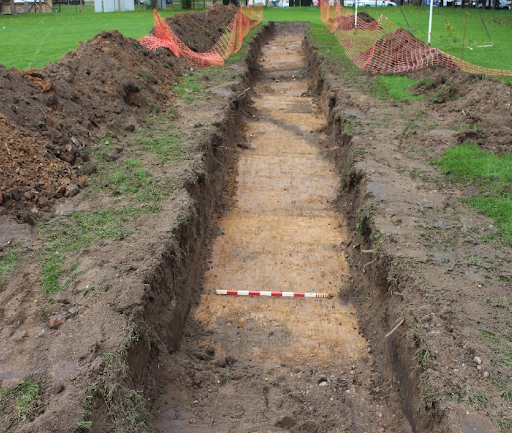
The evaluation comprised thirteen trial trenches distributed across the development area, providing a systematic assessment of the potential for surviving archaeological remains.
HEA maintained oversight of the archaeological programme, managing delivery both on site and through the subsequent reporting process.
Identifying Evidence of Churchbury Farm
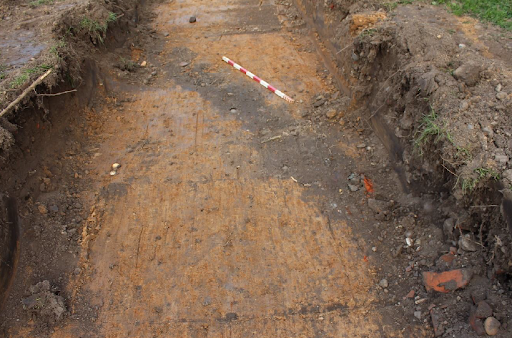
Archaeological features were identified in four of the thirteen trenches. Stratigraphic and artefactual evidence indicated activity dating to the late 19th and early 20th centuries, considered likely to relate to the former Churchbury Farm buildings which had occupied part of the site.
The findings provided physical evidence of the site’s historic agricultural use, complementing the documentary and cartographic evidence identified during the archaeological background assessment.
No significant archaeological remains requiring further investigation were identified. The evaluation successfully established the nature of the surviving remains and provided an appropriate record of this phase in the site’s historic development.
Successful Completion and Condition Discharge
Following completion of the archaeological evaluation and submission of the reporting, the archaeological requirements of Condition 3 were fully discharged by the Local Planning Authority.
The evaluation results were accepted without the need for any further archaeological investigation, allowing the archaeological requirements associated with the redevelopment to be concluded.
A Coordinated Approach to Development Archaeology
This project demonstrates HEA’s role in managing archaeological requirements associated with major development, combining planning advice, specialist contractor coordination, and technical oversight.
From coordinating the preparation and approval of the WSI, through to managing the fieldwork and subsequent reporting, HEA provided continuity across the archaeological programme and ensured the planning requirements were addressed.
The outcome was the successful completion of the archaeological programme and full discharge of the planning condition, with evidence of the site’s former agricultural use recorded and no further archaeological work required.
