

Introduction
HEA was appointed by Edward Projects Ltd to provide archaeological consultancy services in support of new residential development comprising three two-storey houses, with associated parking, access, landscaping, and ancillary facilities, on land to the rear of 49 High Street, Esher, Surrey. The site was located within an area of archaeological interest, with parts falling within Areas of High Archaeological Potential associated with Prehistoric and Anglo-Saxon/Early Medieval occupation, as well as the historic settlement core of Esher.
Archaeological Desk-Based Assessment (ADBA) | Archaeological Consultancy | Archaeological Trial Trench Evaluation
Elmbridge Borough Council
The Challenge
An understanding of the site’s archaeological potential was required to inform the planning application and establish whether the proposed development could affect any surviving archaeological remains.
HEA undertook an Archaeological Desk-Based Assessment (ADBA), reviewing archaeological records, historic mapping, documentary sources, and evidence of previous land use. The assessment identified a medium potential for below-ground archaeological remains dating to the Mesolithic, Iron Age, and Anglo-Saxon/Early Medieval periods, alongside lower to medium potential for Medieval remains.
Although the assessment identified the potential for surviving archaeological remains, it concluded that these were unlikely to represent a significant constraint to development. Elmbridge Borough Council, as advised by the Surrey County Council Historic Environment Planning team, attached an archaeological condition 12 to the planning permission (Ref: 2025/0048), requiring an approved programme of archaeological investigation before development could commence.
The Surrey County Council Historic Environment Planning team identified archaeological trial trench evaluation as an appropriate initial stage of investigation, allowing the archaeological potential of the site and the extent of previous ground disturbance to be established, and determining whether any further work would be necessary.
HEA’s Approach
Following the grant of planning permission, HEA coordinated the archaeological investigation required to address the planning condition.
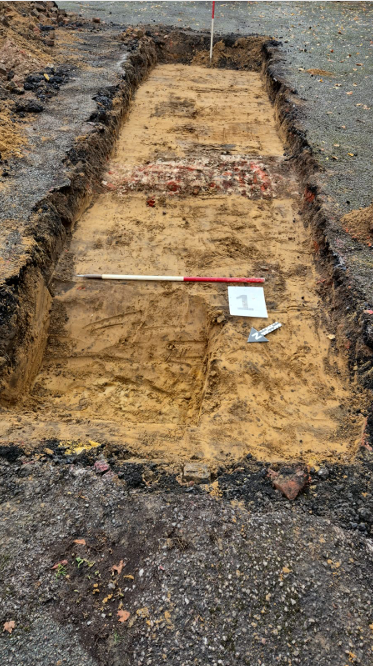
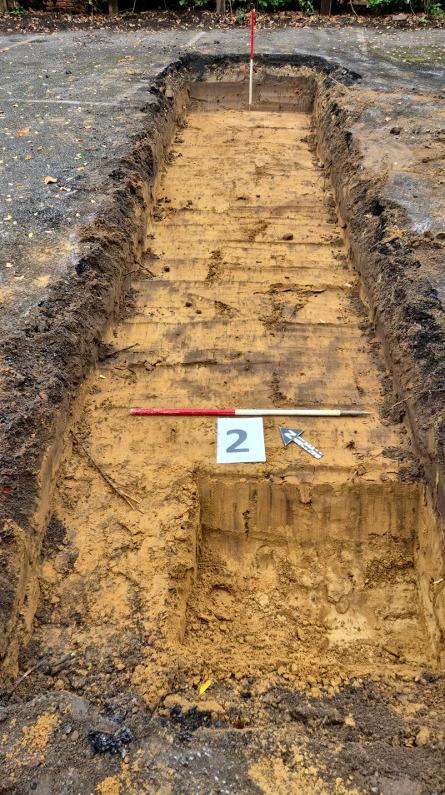
A programme of archaeological trial trenching was undertaken in accordance with an approved Written Scheme of Investigation (WSI). The evaluation was designed to investigate the site’s archaeological potential, establish the nature and significance of any surviving remains, and inform the requirement for any further archaeological mitigation.
The Outcome
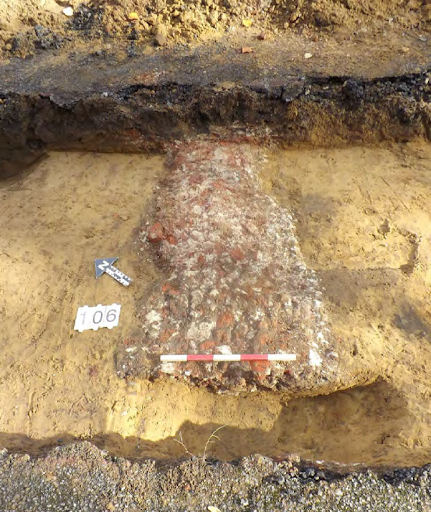
The evaluation identified a small number of features, predominantly of probable 19th-century date, alongside two undated features. No significant archaeological remains were identified, with no evidence of archaeological activity predating the later post-medieval/modern period.
The investigation also indicated that the site had undergone a degree of previous ground reduction, potentially associated with historic landscaping or terracing connected with the former Esher Lodge estate.
Following submission of the archaeological evaluation report, Surrey County Council’s Historic Environment Planning team confirmed that the investigation had satisfactorily addressed the archaeological requirements. Elmbridge Borough Council subsequently confirmed that Condition 12 was fully satisfied, with the Council concluding that no further stages of archaeological mitigation were necessary.
The Result
The project successfully addressed the archaeological planning requirements without the need for further archaeological investigation or mitigation.
Through an evidence-led and proportionate approach, HEA helped the client understand and manage archaeological risk, providing the necessary technical evidence to secure discharge of the archaeological planning condition and enable the development to progress.
HEA’s Contribution
From initial assessment through to archaeological evaluation and discharge of the planning condition, HEA provided a coordinated approach to identifying, managing, and addressing archaeological planning requirements.
The project demonstrates HEA’s commitment to pragmatic, evidence-led archaeological advice that supports development, manages heritage risk proportionately, and delivers commercially effective outcomes.
